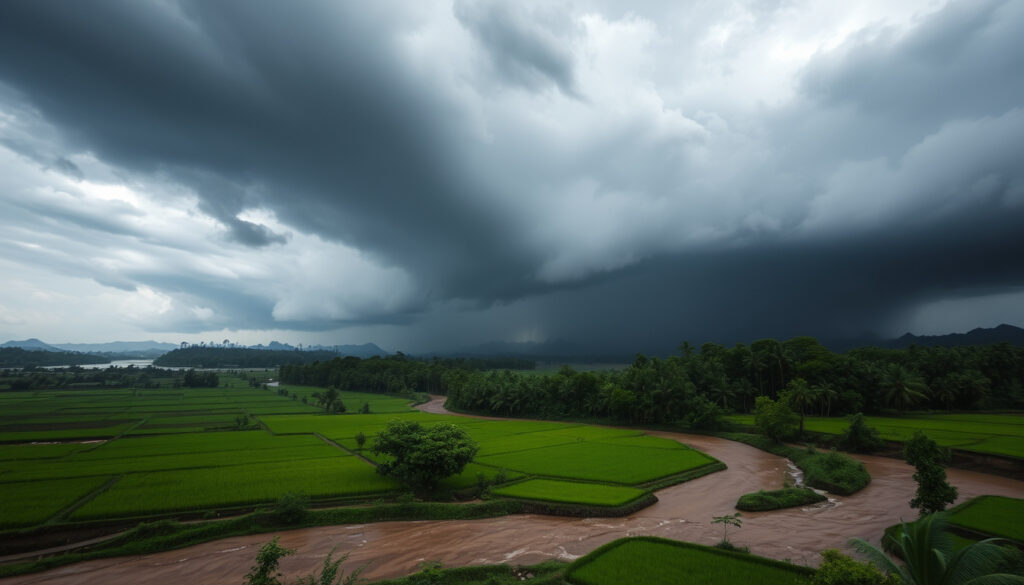
What Is a Monsoon? Definition, Causes, Types & Impacts
Few weather patterns shape daily life the way monsoons do—spanning continents and swinging between bone-dry and drenched within months. Unlike hurricanes, monsoons are not single storms but a continent-scale wind shift that repeats like clockwork each year, bringing both the water crops need and the floods that can wash them away.
Primary Region: Indian Ocean and southern Asia · Key Characteristic: Seasonal reversing wind · Associated Pattern: Wet and dry periods · Not Classified As: Single storm like hurricane · Trigger Mechanism: Land mass heating
Quick snapshot
- Seasonal wind reversal that spans continents (NOAA NESDIS)
- Two types: summer and winter monsoon (Click on Detroit)
- Driven by temperature differences between land and ocean (NOAA NESDIS)
- How European monsoon patterns compare to Asian systems (SERVPRO)
- Precise impacts of long-term climate change on regional monsoon intensity (UCAR Science Education)
- Summer monsoon: April to September (Click on Detroit)
- South Asian peak: June to September (United Restoration FL)
- Predicted rainfall increases as climate warms (UCAR Science Education)
- Ongoing monitoring of North American monsoon shifts (NASA Earthdata)
The key facts table below summarizes the core characteristics of monsoon systems across global regions.
| Field | Value |
|---|---|
| Traditional Scope | Indian Ocean and southern Asia |
| Wind Behavior | Periodic seasonal reversal |
| Precipitation Link | Corresponding changes |
| Scale | Continent-spanning pattern |
| Primary Mechanism | Land mass heating vs ocean cooling |
| Global Systems | Four major: West African, South Asian-Australian, North American, South American |
| Word Origin | Arabic mausim (“season”) |
What Are Monsoons and Why Do They Happen?
A monsoon is a seasonal change in the direction of prevailing winds, not a storm event. The word comes from the Arabic word mausim, meaning season—a clue that monsoons are fundamentally about timing and rhythm rather than a single weather event (NOAA NESDIS). Monsoons are caused by a seasonal shift in winds due to temperature differences between land and water, with monsoon winds always blowing from cold to warm areas (NOAA NESDIS).
What causes a monsoon?
Land cannot hold onto heat as well as the ocean, causing the Intertropical Convergence Zone (ITCZ) to shift toward land regions during summer (UCAR Science Education). During summer months, the land heats up faster than the ocean. This warm air rises over the continent, and cooler, moisture-laden air from the ocean rushes in to replace it—creating the monsoon wind pattern. In winter, the process reverses: the land cools faster than the ocean, and winds blow from land to sea.
The ITCZ follows the sun’s heating, drifting northward in Northern Hemisphere summer and southward in winter. This migration triggers monsoon rainfall in the hemisphere experiencing its summer season, and land heating accelerates the process by drawing the convergence zone over continental land masses.
The South Asian monsoon is especially strong because the Himalayas and other mountains block dry air in the north, trapping moisture and forcing additional rainfall (UCAR Science Education). The seasonal reversal affects continents globally: monsoon systems occur in Asia, India, Australia, Africa, South America, and even North America (NASA Earthdata).
The Sahel region just south of the Sahara Desert in West Africa is a classic monsoon region, demonstrating that the phenomenon is not limited to Asia. Monsoons produce very wet summers and dry winters on nearly all tropical continents.
The pattern is straightforward: summer monsoon brings moist air from the southwest Indian Ocean to countries like India, Sri Lanka, Bangladesh, and Myanmar; the winter monsoon blows drier air to the region from northwestern China and Mongolia (Click on Detroit). Winter monsoons are not as powerful or deadly as summer monsoons.
The implication: monsoon intensity and predictability depend heavily on regional geography. Mountains like the Himalayas can amplify a monsoon system, while flat continental interiors may experience weaker effects. This explains why the South Asian system is the world’s strongest.
Is Monsoon a Storm?
No—a monsoon is not a single storm like a hurricane or thunderstorm. Unlike hurricanes, monsoons are not circular storms and involve broad, continent-spanning wind pattern shifts that unfold over months (United Restoration FL). A tropical cyclone requires sustained winds of at least 74 mph (119 km/h), while a monsoon is a seasonal shift in winds that often causes a very rainy season or a very dry season (NOAA NESDIS).
Is monsoon the same as a hurricane?
No. Hurricanes are concentrated circular storms with minimum sustained winds of 74 mph, forming over warm ocean waters and lasting days to weeks. Monsoons are broad wind pattern shifts lasting months, driven by seasonal temperature differences between land and ocean. The two systems can interact—a hurricane can dump extraordinary rainfall within a monsoon season—but they are fundamentally different phenomena.
What is a monsoon storm?
The phrase “monsoon storm” is misleading. Monsoons are not storm events; they are large-scale seasonal wind patterns that bring alternating wet and dry periods. When people refer to a “monsoon storm,” they typically mean the intense rainfall that can occur during the wet phase of a monsoon season.
Monsoons can cause catastrophic flooding when persistent rainfall overwhelms rivers and drainage systems. Summer monsoons bring the heaviest rainfall and the highest flood risk. The South Asian monsoon dominates countries such as India, Bangladesh, and Thailand from June through September, with the potential for devastating floods.
The distinction matters for emergency planning. Hurricanes trigger immediate, localized responses—evacuation orders, storm surge warnings. Monsoons require long-term preparedness: infrastructure that can handle months of alternating flood and drought conditions, water management systems, and agricultural planning.
What Are Two Types of Monsoons?
There are two different types of monsoons: the summer monsoon and the winter monsoon (Click on Detroit). The summer monsoon typically occurs between April and September and brings wet conditions. The winter monsoon occurs between October and April and brings drier conditions. The two types create the alternating wet and dry seasons that define monsoon climates.
What are the 4 types of rain?
While monsoons are not directly classified by rain types, meteorologists identify four primary precipitation mechanisms: orographic (mountain-induced), convective (thermal heating), frontal (air mass collision), and cyclonic (low-pressure systems). Monsoon rainfall primarily combines convective and orographic mechanisms—summer heating creates rising air that condenses, while mountain ranges like the Himalayas force additional uplift and rainfall.
There are four major global monsoon systems: West African, South Asian-Australian, North American, and South American (Wikipedia). Monsoons occur in the Americas but tend to be weaker than in other regions (UCAR Science Education).
The summer monsoon brings the most rainfall and therefore the most dramatic effects. The winter monsoon reverses direction, typically bringing drier air. The most reliable monsoon is the summer monsoon—both in terms of timing and rainfall volume. During Northern Hemisphere winter, the ITCZ is south of the equator and monsoon rains fall in northern Australia (UCAR Science Education).
The pattern: summer monsoons bring the water that agriculture depends on; winter monsoons, while weaker, can intensify drought conditions and increase wildfire risk in some regions. Neither type should be dismissed—both shape the human and natural landscapes of monsoon regions profoundly.
Does Monsoon Mean Heavy Rain?
Monsoons involve a shift in winds that often causes a very rainy season or a very dry season—they are not defined solely by rainfall amount (NOAA NESDIS). Heavy rain is a characteristic of the wet phase, but the monsoon system itself is about wind reversal and seasonal climate shifts. The wet phase can bring significant precipitation; the dry phase brings little to none.
What is monsoon climate?
A monsoon climate is characterized by distinct wet and dry seasons driven by seasonal wind reversals. Regions with monsoon climates receive the majority of their annual rainfall during the summer months when the monsoon is active, and experience prolonged dry periods during winter. Monsoons produce very wet summers and dry winters on nearly all tropical continents (UCAR Science Education).
The Tian Shan Mountains receive approximately 70% of their annual precipitation during the three summer months under monsoon influence (Wikipedia). This concentration of rainfall demonstrates how monsoon climates concentrate water resources into narrow seasonal windows—critical for agriculture but also for flood management.
Florida’s rainy season (May to October) shares similar features to monsoons with sustained moisture and frequent thunderstorms, though it is not formally classified as a monsoon season (United Restoration FL). The distinction lies in the scale and driver: true monsoons involve continent-scale wind reversals, while Florida’s pattern is driven primarily by local convective processes.
The trade-off: monsoon regions benefit from highly predictable seasonal water availability—the wet phase reliably brings crops the water they need—but this same predictability means communities must prepare for both flood and drought cycles. Infrastructure that handles months of heavy rain must also bridge months of near-zero precipitation.
What Country Is Most Affected by Monsoons?
India is most heavily affected by monsoons—the South Asian monsoon dominates the country from June through September, and the entire agricultural system is built around the monsoon cycle (United Restoration FL). Bangladesh and Thailand also experience intense monsoon effects. The South Asian monsoon is especially strong because the Himalayas and other mountains block dry air in the north, trapping moisture and amplifying rainfall (UCAR Science Education).
Are there monsoons in Europe?
Europe does not experience traditional monsoon patterns comparable to South Asia or West Africa. The continent’s geography—bounded by oceans and lacking large land masses at the right latitude—does not create the land-sea temperature differentials that drive monsoon formation. Some European regions experience seasonal rainfall variations, but these are driven by frontal systems rather than monsoon wind reversals. Monsoons are most frequently associated with the Indian Ocean, though they also affect Africa, Australia, and the Americas (SERVPRO).
The North American monsoon affects regions including Arizona and New Mexico, demonstrating that monsoon systems occur well beyond traditional Asian contexts (NASA Earthdata). Arizona weather agencies defined the monsoon season as June 15 to September 30 in 2008, and the key to the North American monsoon is the shift in wind direction each summer, from westerly winds to southerly winds, bringing moisture from the Pacific Ocean and Gulf of California (Arizona State University).
The implication: for billions of people in South Asia, the monsoon is not background weather—it is the water supply, the agricultural calendar, and the annual disaster risk rolled into one predictable cycle. A weak monsoon can mean drought and famine across nations that have no alternative water source.
Monsoons are not just about rain, they are a dramatic seasonal shift in wind patterns.
— UCAR Science Education
A monsoon is not a storm like a hurricane or a summer thunderstorm—it is a shift in winds that often causes a very rainy season or a very dry season.
— NOAA NESDIS
A monsoon is a seasonal change in the direction of prevailing winds of a region, not a storm.
— SERVPRO
Related reading: What is my rising sign · What does melanoma look like
Frequently Asked Questions
Is monsoon good or bad?
Monsoons are neither inherently good nor bad—they are a natural seasonal pattern that regions have adapted to over millennia. The wet phase provides essential water for agriculture, drinking, and ecosystems. The dry phase provides needed dry periods. However, monsoons can bring flooding during the wet phase and drought during the dry phase, making them challenging for communities that lack infrastructure to manage extreme water cycles.
Are monsoons dangerous?
Summer monsoons are not themselves dangerous, but the flooding they produce can be catastrophic. When persistent rainfall continues for days over mountains and floodplains, water accumulates faster than rivers and drainage systems can handle, leading to flash floods, river overflows, and infrastructure damage. Winter monsoons are generally less powerful and less dangerous, though they can worsen drought conditions.
What is a monsoon for kids?
A monsoon is when the wind changes direction with the seasons, bringing either lots of rain or dry weather. Think of it like the weather having a “wet season” and a “dry season” every year—like having a rainy season every summer that lasts for months. The word comes from an Arabic word meaning “season.”
What is a monsoon in geography?
In geography, a monsoon is a large-scale seasonal wind system that reverses direction between summer and winter, caused by temperature differences between land and ocean. Monsoons produce alternating wet and dry seasons across tropical and subtropical regions, primarily affecting Asia, Africa, Australia, and parts of the Americas.
Who gets more rain, England or Ireland?
Neither England nor Ireland experiences true monsoon conditions—monsoons are defined by seasonal wind reversals, not rainfall totals. Both countries have maritime climates with year-round precipitation distributed relatively evenly. The traditional monsoon regions with dramatic wet-dry seasonal switches are found in tropical and subtropical regions, not northwestern Europe.
How is climate change affecting monsoons?
Computer simulations predict an increase in rainfall in most monsoon regions as climate warms over the next 50 to 100 years. Warm air can hold more water vapor, which will produce more rain in the ITCZ as climate warms. This means monsoon regions may face more intense rainfall events and increased flood risk, though the timing and reliability of monsoon seasons may also shift.
More related posts
 Sonam Kapoor Second Baby at 40: Age, IVF & Bollywood Moms
 Apple Music for Artists: Claims, Payouts & Spotify Guide
 UndergrowthGames Custom Controller UGGControMan – Specs, Customization and Comparisons
 Pacers vs Thunder Game 7: Thunder Win NBA Finals 103-91
 Tyler Perry Net Worth – $1.4 Billion in 2024
 Happiest Countries in the World 2026: Top 10 Rankings & Insights
 Water Purification System Whole House – Top 2025 Picks and Reviews
 Canada Benefits for Low-Income 2025: Eligibility & How to Apply
