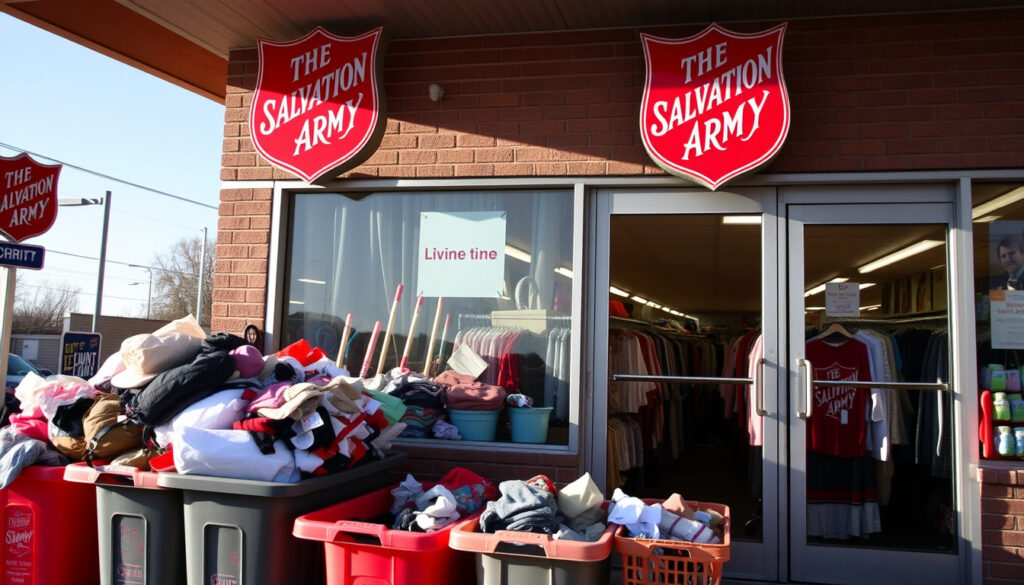
Salvation Army Thrift Store: Donations, Shops & Locations
Salvation Army thrift stores — charity shops in the UK — serve dual roles as retail outlets and fundraising mechanisms. Every bag dropped off or item bought helps fund rehabilitation programs, making your old coat do double duty. This guide covers what these shops accept, where to find them, and what actually happens to your donations.
Shops in UK: over 400 · Donation centres in UK: over 20 · Residential centres in Dublin: 6
Quick snapshot
- Proceeds fund Adult Rehabilitation Centers (Salvation Army UK Official)
- Over 400 UK charity shops from one network (Salvation Army UK Official)
- Pickup and drop-off options available across regions (Salvation Army UK Official)
- Exact prices vary by individual location
- Specific clothing bank count for Republic of Ireland alone
- Regional variations in accepted item lists between UK divisions
- The organization opened one of the first charity shops in the 19th century (Salvation Army UK Official)
- Ireland divisional map updated November 2024 (Salvationist UK Official)
- Door-to-door collection services expand accessibility for donors
- Specialist furniture shops offer free pickup for larger items
- Online location finder helps map nearest drop-off points
The table below consolidates verified statistics about Salvation Army retail operations across the UK and Ireland.
| Fact | Value |
|---|---|
| UK Charity Shops | Over 400 |
| UK Donation Centres | Over 20 |
| Clothing Banks Across UK | Approximately 8,000 |
| Dublin Address Example | 114 Marlborough Street |
| Funds | Adult Rehabilitation Centers |
What is The Salvation Army thrift store?
Salvation Army thrift stores — called charity shops in the UK — are retail outlets operated by the Salvation Army Trading Company (SATCoL), which manages charity shops, donation centres, and clothing banks in the UK and Republic of Ireland (Salvation Army UK Official). The organization opened one of the first charity shops in the 19th century, originally providing affordable clothing to people who couldn’t otherwise afford it.
History and mission
- Founded as part of the wider Christian charitable mission of The Salvation Army
- Operates as a social enterprise where proceeds directly fund community programs
- Today manages over 400 charity shops across the UK (Salvation Army UK Official)
The implication is that this century-spanning mission continues to balance retail operations with social purpose, making each purchase or donation part of a larger charitable framework.
How proceeds are used
Sales from Salvation Army shops fund the organization’s Adult Rehabilitation Centers, which provide programs for individuals recovering from alcohol and drug addiction (Salvation Army Thrift Stores US). The UK operation collects, reuses, recycles, and sells more than 50 million items per year.
The pattern shows that the UK and US operations fund the same rehabilitative mission through different retail mechanisms — donations fuel recovery programs on both sides of the Atlantic.
When you donate a bag of clothes or buy a jacket from a Salvation Army shop, you’re directly funding rehabilitation services. The organization states: “Donating to our shops and buying our goods helps you save money, and us save lives.”
What items does The Salvation Army not accept?
Each Salvation Army region sets its own acceptance guidelines, and understanding these rules prevents wasted trips. Standard UK charity shops have clearer restrictions than US thrift stores, which accept a broader range of items.
Common non-accepted items
- UK standard shops: Electrical items, small furniture, or large furniture are not accepted at regular charity shops (Salvation Army UK Official)
- US stores: Appliances with mechanical difficulties, missing power cords, rust, dirt, or any gas appliances are refused (Salvation Army Thrift Stores US)
- US stores: Paint, chemicals, kerosene, or gas heaters are explicitly prohibited (Salvation Army Thrift Stores US)
Reasons for restrictions
Safety concerns drive most restrictions. Gas appliances, chemicals, and compromised electrical items pose hazards to staff and shoppers. Furniture restrictions at standard shops exist because dedicated specialist furniture shops handle those donations with proper collection logistics.
Two specialist charity furniture shops operate in the UK: one on Wellington Street in Luton and one on Dumbarton Road in Glasgow. Both provide free collection services for furniture donations (Salvation Army UK Official).
The catch is that donors must know which shop type handles their specific items — standard charity shops won’t accept furniture, but the specialist shops in Luton and Glasgow will collect it free of charge.
Donations must be in good condition and handed to staff or volunteers during opening hours at UK Salvation Army shops. Clothing banks offer 24/7 drop-off for textiles, but standard donations require staffed hours.
Are there Salvation Army thrift stores in Ireland?
Yes — The Salvation Army operates throughout Ireland with a documented divisional structure. An official divisional map was published in November 2024 showing service locations across the Republic (Salvationist UK Official). While specific retail shop counts for Ireland aren’t publicly broken out from UK totals, the organization maintains a visible presence in Dublin and other cities.
Locations in Dublin
- The Salvation Army Ireland operates with divisional centres documented in official maps
- One Dublin example address: 114 Marlborough Street
- Residential centres provide shelter services alongside thrift operations
Other thrift options in Ireland
Irish residents also use term “charity shop” for thrift stores, though some smaller independent operations exist. The Salvation Army competes with other charity retailers in the Irish market, though direct comparisons to US chains like Goodwill are less applicable since Goodwill doesn’t operate in Ireland.
Is The Salvation Army Catholic or Protestant?
The Salvation Army is a Christian denomination with roots in the Wesleyan Methodist tradition, founded in London in 1865. It’s neither Catholic nor Protestant in the traditional sense — it’s an evangelical church body that operates both religious services and extensive social programs, including thrift stores.
Denominational background
The organization classifies itself as part of the broader Christian church, specifically identifying with Protestant evangelical Christianity. Its military-style structure and uniformed officers are distinctive features of its tradition. The religious mission drives the charitable work, meaning thrift store operations exist to fund both spiritual programs and practical community support.
What this means is that donors and shoppers engage with an organization whose charitable retail is inseparable from its faith-based rehabilitation mission — purchases and donations directly support both spiritual and social programs.
What is the most needed item to donate to thrift stores?
Quality clothing remains the most needed donation type for most charity shops. Organizations report that gently worn, clean garments in acceptable condition move quickly through retail floors. According to charitable giving research, clean clothing and linens are prioritized because they require minimal processing before resale.
Best items for charities
- Good quality clothing and accessories
- Linens and homeware in usable condition
- Books, CDs, DVDs, and toys
- Bicycles, sports equipment (US stores)
Donation guidelines
All high-quality products donated to Salvation Army charity shops and donation centres are offered for sale in-store (Salvation Army UK Official). The organization states it believes nothing should be left forgotten at the back of wardrobes or garages, or worse, sent to landfill.
What this means is that donors should focus on clean, wearable items in good condition — these sell fastest and generate the most funding for rehabilitation programs.
Thanks to you we collect, reuse and recycle and sell more than 50 million items a year that directly goes to our work helping others at the heart of communities across the UK and Republic of Ireland.— Salvation Army UK Official statement
Our Charity Shop has been called Chelsea’s hidden gem!— Chelsea Charity Shop description
For UK donors, the implication is clear: your donations fuel a network that processes 50 million items annually and funds rehabilitation across both countries. For Dublin residents specifically, the Salvation Army’s documented divisional presence means your drop-offs support local shelter and social services alongside national programs.
Related reading: Shoppers Drug Mart Medicine Hat: Hours, Locations & Services
salvationarmy.org.uk, salvationist.org.uk, salvationarmy.org.uk, salvationarmy.org.uk
With over 400 Salvation Army charity shops spanning the UK, dedicated donation centres and clothing banks make giving easy for locals.
Frequently asked questions
Do thrift stores wash clothes before selling?
Generally no — donated items are sold as received. Some shops may spot-clean items, but bulk washing isn’t standard practice. Buyers should expect to launder garments before wearing.
How cheap is a Salvation Army thrift store?
Prices vary by location, item type, and condition. Most clothing items cost a fraction of retail prices, often £1–£15 in UK shops. Electronics, furniture, and designer pieces may command higher prices depending on resale value.
What do Irish call thrift stores?
Irish people commonly use “charity shop” to refer to thrift stores, similar to UK terminology. The term “jumble sale” may also appear for pop-up or fundraising events.
Can you put knickers in a clothes bank?
Yes — clothing banks accept underwear and lingerie as long as items are clean. The banks process textiles for reuse or recycling, diverting items from landfill.
What are Salvation Army drop-off hours?
Standard charity shop hours vary by location. For example, the Chelsea Charity Shop in London operates Monday to Thursday from 10:00am until 2:00pm (Salvation Army UK Official). Clothing banks offer 24/7 drop-off outside most locations.
Is there a Salvation Army thrift store online?
The Salvation Army doesn’t operate a centralized online store. However, some individual shops may list inventory through local platforms. For donation scheduling, the US operation offers an online pickup request system at satruck.org.
What items are most needed for donation?
Quality clothing, accessories, linens, homeware, books, CDs, DVDs, and toys are most needed. Electrical items, furniture, and chemicals have specific restrictions — check with your local shop before dropping off.
More related posts
 Kijiji Ville de Québec: Rental , Car & Free Stuff Guide
 Athletic Club vs Real Madrid – Preview, Lineups, Prediction
 37.5 Celsius to Fahrenheit – Exact Conversion and Health Context
 Water Purification System Whole House – Top 2025 Picks and Reviews
 Cast of A Very Jonas Christmas Movie: Full List & Cameos
 Braun Silk Expert Pro 5 IPL Review: Specs, Pricing, Comparisons
 Prayer Times in Laval: Quebec and France Schedules
 Does Not Equal Sign – Alt Codes, Shortcuts and Usage Guide
