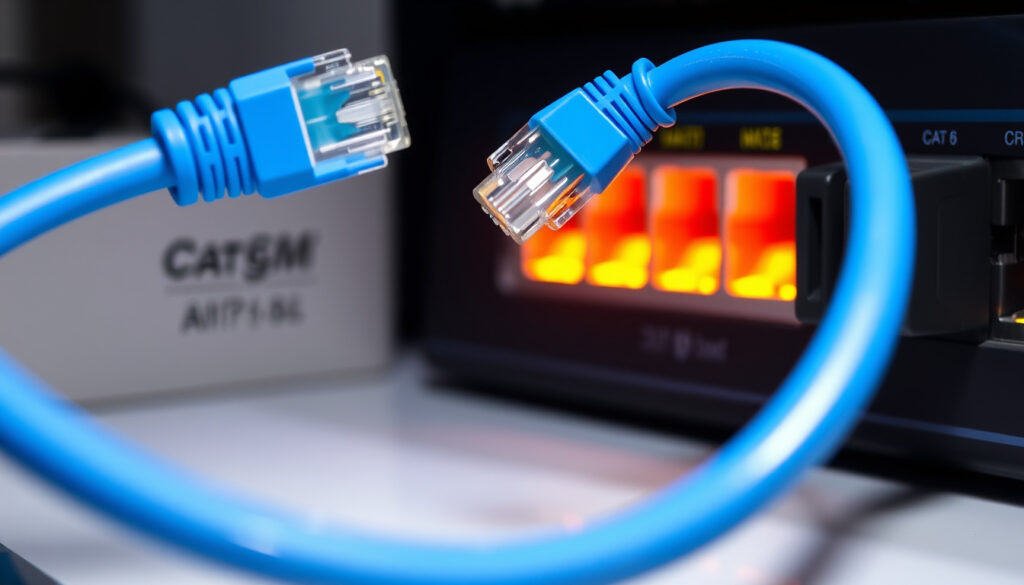
Cat 6 Ethernet Cable – Specs, Performance and Buying Guide
Cat 6 Ethernet cable represents one of the most widely deployed networking standards in homes and businesses worldwide. Supporting transmission speeds up to 10 gigabits per second over limited distances, this cable category delivers meaningful performance improvements over its predecessor, Cat 5e, while remaining significantly more affordable than newer alternatives like Cat 6a or Cat 7.
Whether setting up a home office, upgrading business infrastructure, or building a gaming setup, understanding what Cat 6 cables offer helps in making informed purchasing decisions. The standard has matured considerably since its introduction, with certified cables now widely available at competitive price points.
This guide examines the technical specifications, practical limitations, and real-world applications of Cat 6 Ethernet cables, providing the information needed to determine whether this cable category suits a particular networking requirement.
What Is Cat 6 Ethernet Cable?
Cat 6, formally known as Category 6, is a standardized cable specification defined under TIA/EIA-568-B for twisted-pair copper wiring in Ethernet networks. The specification was developed to support higher bandwidth applications and faster data transmission rates than earlier Category 5e cables could handle reliably.
Max Speed (55m)
Bandwidth
Standard Length
Full Distance Speed
Key insights about Cat 6 cable:
- Supports up to 10 Gbps speeds, but only over distances up to 55 meters due to alien crosstalk (ANEXT) limitations
- Operates at full 1 Gbps capacity across the standard 100-meter channel length defined by TIA/EIA-568
- Offers 2.5 times the bandwidth of Cat 5e (250 MHz versus 100 MHz), reducing signal degradation and latency
- Incorporates an internal spline in many designs to further reduce crosstalk between wire pairs
- Uses standard RJ45 connectors, maintaining backward compatibility with existing network equipment
- Costs approximately 10-20% more than Cat 5e while delivering substantially better performance for demanding applications
- Represented the standard for gigabit Ethernet deployment throughout the 2010s as network speeds increased
| Specification | Value | Notes |
|---|---|---|
| TIA Standard | TIA/EIA-568-B | U.S. cabling standard for commercial installations |
| Bandwidth Rating | 250 MHz | Supports high-frequency data transmission |
| Maximum Speed at 100m | 1 Gbps | Full gigabit speed at standard length |
| 10 Gbps Distance | 55 meters | Limited by alien crosstalk at higher frequencies |
| Shielding Options | UTP (standard) or F/UTP | Spline feature in many unshielded variants |
| Connector Type | RJ45 (8P8C) | Standard Ethernet connector, backwards compatible |
| PoE Support | PoE+ (30W) standard | Handles most IP cameras and access points |
Cat 6 vs Cat 5e: Key Differences
Understanding the distinctions between Cat 6 and Cat 5e helps determine whether the performance benefits justify the modest cost increase for a specific installation.
Technical Specifications Comparison
The fundamental difference lies in bandwidth capacity. Cat 5e cables support 100 MHz, while Cat 6 doubles this to 250 MHz. This higher bandwidth enables Cat 6 to handle faster data transmission without signal degradation. The tighter twist ratios and additional spline construction in Cat 6 cables provide superior protection against crosstalk, including both near-end crosstalk (NEXT) and alien near-end crosstalk (ANEXT).
When running at 10 Gbps speeds, Cat 5e fails entirely, whereas Cat 6 maintains this speed up to 55 meters. For standard 100-meter installations at 1 Gbps, both cables perform adequately, but Cat 6 provides headroom for future upgrades without requiring cable replacement.
For most residential applications where devices connect at 1 Gbps, Cat 5e remains sufficient. Cat 6 becomes the clear choice when running cable in commercial environments, connecting servers, or preparing for 10 Gbps network hardware.
Real-World Application Differences
In practice, the difference between Cat 5e and Cat 6 manifests most noticeably in high-bandwidth scenarios. Video streaming, large file transfers, and network-attached storage (NAS) operations benefit from the reduced latency and improved signal integrity that Cat 6 provides. Gaming environments also see advantages from the more consistent data delivery that the higher-specification cable offers.
Installation quality matters significantly. Poorly terminated Cat 6 cables can underperform properly installed Cat 5e runs. Certification testing using tools like Fluke cable analyzers ensures installations meet the published specifications and qualify for manufacturer warranties.
How Far Can Cat 6 Cable Transmit Data?
The maximum transmission distance for Cat 6 Ethernet cable follows the TIA/EIA-568 standard of 100 meters (328 feet) for rated performance. This 100-meter limit encompasses the entire channel from the network switch to the connected device, typically comprising a 90-meter permanent link and 10 meters of flexible patch cable at each end.
Speed Variation Over Distance
Cat 6 cables exhibit different performance characteristics depending on the data rate and cable length involved. At 1 Gbps, the full 100-meter distance presents no challenges. However, when operating at 10 Gbps, the usable distance decreases to approximately 55 meters before signal integrity degrades below acceptable thresholds due to alien crosstalk interference.
This distance limitation stems from the higher frequency signals required for 10 Gbps transmission. At these frequencies, electromagnetic interference between adjacent cable pairs and neighboring cables becomes more pronounced. The ANEXT effect intensifies as cable length increases, eventually making reliable communication impossible without repeaters or specialized equipment.
| Distance Range | Maximum Speed | Application Notes |
|---|---|---|
| 0-55 meters | 10 Gbps | Suitable for server connections, high-performance workstations |
| 55-100 meters | 1 Gbps | Standard office and residential installations |
| Beyond 100 meters | Signal regeneration required | Network extenders or fiber required |
Factors Affecting Maximum Distance
Several environmental factors influence how far Cat 6 cable can reliably transmit data. Electromagnetic interference (EMI) from motors, fluorescent lighting, radio transmitters, and other electrical equipment can reduce effective distance. Running cables parallel to electrical wiring, particularly AC power lines, exacerbates this interference.
Cable quality varies significantly between manufacturers. Budget cables may not achieve the full 100-meter specification, particularly at elevated temperatures. Installation practices, including minimum bend radius requirements (typically four times the cable diameter) and proper separation from interference sources, directly impact performance.
Shielding, PoE, and Compatibility in Cat 6 Cables
Beyond basic specifications, several practical considerations influence which Cat 6 cable configuration suits particular installations.
Shielding Options for Cat 6
Standard Cat 6 cables use unshielded twisted pair (UTP) construction, relying on the twist ratio and internal spline to minimize crosstalk. Shielded variants, designated F/UTP (foil shielded under the outer jacket), provide additional protection against external electromagnetic interference. The BICSI standards organization and Ethernet Alliance recommend shielded cabling in environments with significant EMI, such as industrial facilities, hospitals with imaging equipment, or areas adjacent to heavy machinery.
Shielded Cat 6 cables require proper grounding at one end of the run. Improperly grounded shielded cables can actually perform worse than unshielded alternatives due to ground loop interference and antenna effects.
Power over Ethernet Capabilities
Cat 6 cables fully support Power over Ethernet (PoE) standards, including PoE (15.4W), PoE+ (30W), and to a reasonable extent PoE++ (60-90W). The IEEE 802.3bt standard for PoE++ achieves maximum power delivery more reliably with Cat 6a due to superior thermal performance in cable bundles, but Cat 6 handles typical PoE+ applications without issues.
Common PoE-powered devices include IP security cameras, wireless access points, VoIP phones, and building automation sensors. Running Cat 6 to these locations simplifies installation by eliminating separate power runs.
Backward Compatibility
All Cat 6 cables maintain full backward compatibility with lower category standards. They work seamlessly with Cat 5e, Cat 5, and even Cat 3 equipment using standard RJ45 connectors. This compatibility extends to all Ethernet standards from 100 Mbps through 10 Gbps, following IEEE 802.3 specifications.
Connecting Cat 6 cables to older hardware automatically negotiates the highest mutually supported speed. The only limitation involves older punch-down blocks or substandard connectors that may not meet Cat 6 performance requirements even when using high-quality cable.
How to Choose the Best Cat 6 Ethernet Cable
Selecting appropriate Cat 6 cables involves considering the installation environment, performance requirements, and budget constraints.
Indoor Residential Installations
For home networks connecting computers, game consoles, streaming devices, and smart home hubs, standard CM-rated Cat 6 patch cables or in-wall cables work well. Solid conductor Cat 6 cables suit in-wall permanent installations, while stranded conductor cables provide better flexibility for visible runs behind furniture or to device connections.
The Water Purification System Whole House – Top 2025 Picks and Reviews comparison demonstrates how similar buying guide principles apply across different technology categories.
Commercial and Office Environments
Commercial installations typically require plenum-rated Cat 6 cables when running through air handling spaces. CMR (riser-rated) cables suffice for between-floor runs that do not enter HVAC ductwork. For new office builds, Cat 6a has become the TIA-recommended minimum for structured cabling, offering full 100-meter 10 Gbps capability and superior PoE++ thermal performance.
Gaming and High-Performance Applications
Gaming setups benefit from Cat 6 or Cat 6a cables when connecting to 10 Gbps network adapters. While most home routers still max out at 1 Gbps, gaming PCs with 2.5 Gbps or 10 Gbps Ethernet ports see meaningful latency and throughput improvements from higher-specification cables.
The Insta 360 Go 3S – Specs, Review and GO 3 Comparison demonstrates how different technology categories approach comparison shopping, a practice equally valuable when selecting networking equipment.
Outdoor and Industrial Installations
Outdoor Cat 6 installations require cables with UV-resistant jackets and appropriate environmental ratings. Direct burial applications need gel-filled construction to prevent moisture penetration. Shielded outdoor cables provide additional protection against lightning-induced surges and industrial EMI.
Standard indoor Cat 6 cables degrade rapidly when exposed to outdoor conditions. Always verify that outdoor-rated cables carry appropriate certifications for their intended environment.
The Evolution of Cat 6: A Timeline
Understanding the development history places Cat 6 cables in proper context within the broader evolution of Ethernet standards.
- 2002 – The TIA/EIA-568-B.2-1 standard formally ratified Category 6, establishing the specifications that define the cable category.
- 2004-2006 – Widespread commercial adoption began as gigabit Ethernet became standard in business networks.
- 2010s – Cat 6 became the dominant standard for new residential and commercial installations as costs decreased and 1 Gbps became universal.
- 2016 – Cat 6a specification (TIA/EIA-568-C.2) established, offering full 100-meter 10 Gbps capability for installations requiring higher performance.
- 2018-2020 – PoE++ (IEEE 802.3bt) adoption increased demand for higher-specification cables capable of delivering up to 90 watts per port.
- 2020s – Wi-Fi 6 and Wi-Fi 6E access points drove increased wired infrastructure investment, with Cat 6a becoming preferred for high-density deployments.
- Present – Cat 6 remains widely deployed while Cat 6a gains ground in new commercial installations requiring full 10 Gbps capability.
Myths and Facts About Cat 6 Cables
Several misconceptions persist regarding Cat 6 cables and their performance characteristics. Examining these claims helps separate marketing hyperbole from technical reality.
| Claim | Reality |
|---|---|
| All Cat 6 cables support 10 Gbps at 100 meters | Cat 6 only supports 10 Gbps up to 55 meters. Beyond this distance, speeds drop to 1 Gbps or lower. |
| Shielded Cat 6 always performs better | Shielded cables require proper grounding. Improperly installed shielded cables can perform worse than quality unshielded alternatives. |
| Cat 6 is the same as Cat 6a | Cat 6a offers 500 MHz bandwidth (versus 250 MHz), supports full 100-meter 10 Gbps, and has more robust construction to prevent alien crosstalk. |
| Higher category cables automatically improve network speed | Speed depends on the entire chain: network hardware, cable, and connected devices. Cat 5e at 1 Gbps performs identically to Cat 6 at 1 Gbps. |
Standards and Certifications
Multiple organizations define the standards governing Cat 6 cables, each contributing different aspects to the specification and testing framework.
The Telecommunications Industry Association (TIA) establishes the physical and electrical specifications for U.S. copper cabling through TIA/EIA-568 standards. These specifications define performance parameters that certified cables must meet during testing.
The Institute of Electrical and Electronics Engineers (IEEE) develops Ethernet standards including the various speed grades and Power over Ethernet specifications found in IEEE 802.3.
Independent testing organizations such as BICSI provide installation training and certification programs that ensure technicians understand proper practices for achieving rated cable performance.
“Certified cable installations passing Fluke testing qualify for manufacturer warranties and ensure the channel meets TIA standards for the specified category.”
Cat 6 and Future-Proofing Networks
For most residential applications and smaller commercial installations, Cat 6 remains a viable choice through at least 2030. The standard handles current gigabit requirements easily and provides headroom for emerging technologies like Wi-Fi 7 access points, which may push wired infrastructure toward multi-gigabit speeds.
However, installations requiring full 10 Gbps capability over 100-meter distances should consider Cat 6a. The marginal cost difference at installation time becomes insignificant when weighed against the expense of replacing cables in completed buildings.
Cat 7 cables, while offering 600 MHz bandwidth and 10 Gbps over 100 meters, are not TIA-recognized and use non-standard connectors (GG45 or TERA) rather than RJ45. North American versions with RJ45 connectors perform identically to Cat 6a under TIA testing, making them a confusing choice that offers no practical advantage.
Summary
Cat 6 Ethernet cable delivers reliable performance for gigabit networks across standard 100-meter distances, with bonus capability for 10 Gbps speeds up to 55 meters. The 250 MHz bandwidth and improved crosstalk resistance over Cat 5e make it suitable for demanding applications including video streaming, large file transfers, and network-attached storage.
For new installations expecting to support 10 Gbps devices, Cat 6a represents the safer long-term investment. Pure Cat 6 works well for budget-conscious projects where gigabit speeds suffice and future upgrades may involve complete cable replacement anyway.
Proper installation practices and certification testing ensure Cat 6 cables achieve their rated performance. Whether upgrading an existing network or planning new infrastructure, Cat 6 remains a practical choice for most networking requirements.
Frequently Asked Questions
What is the maximum length for Cat 6 Ethernet cable?
The maximum length is 100 meters (328 feet) at rated speeds per TIA/EIA-568 standards. At 10 Gbps, the usable distance decreases to approximately 55 meters before signal degradation becomes problematic.
Is Cat 6 cable backwards compatible?
Yes. Cat 6 cables work with Cat 5e, Cat 5, and Cat 3 equipment using standard RJ45 connectors. The connection automatically negotiates the highest mutually supported speed, from 100 Mbps to 10 Gbps.
Can Cat 6 handle 10Gbps?
Cat 6 supports 10 Gbps speeds, but only over distances up to approximately 55 meters. Beyond this distance, performance degrades to 1 Gbps or lower. For full 100-meter 10 Gbps capability, Cat 6a is required.
Does Cat 6 need to be shielded?
Not necessarily. Standard unshielded Cat 6 (UTP) handles most residential and office environments adequately. Shielded cables become beneficial in high-EMI environments such as industrial facilities, but require proper grounding to function correctly.
Is Cat 6 better than Cat 5e?
Cat 6 offers 2.5 times the bandwidth (250 MHz vs. 100 MHz), supports 10 Gbps for short runs, and provides better crosstalk resistance. However, for standard 1 Gbps installations at full 100-meter distances, both cables perform similarly, with Cat 6 providing more headroom for future upgrades.
Can Cat 6 be used for Power over Ethernet?
Cat 6 fully supports PoE (15.4W) and PoE+ (30W). It handles most PoE++ (60W) applications adequately, though Cat 6a offers better thermal performance for high-wattage PoE++ (90W) in bundled cable runs.
What is the difference between Cat 6 and Cat 6a?
Cat 6a provides 500 MHz bandwidth (versus 250 MHz), supports full 100-meter 10 Gbps, and has more robust construction to eliminate alien crosstalk. Cat 6a cables are slightly larger and more expensive than Cat 6.
Is Cat 7 better than Cat 6?
Cat 7 is not TIA-recognized and requires non-standard connectors. RJ45 versions of Cat 7 perform identically to Cat 6a in testing. For most applications, Cat 6 or Cat 6a provides better value and compatibility than Cat 7.
More related posts
 Olivia Dunne: Biography, Age, Height, Net Worth & Relationship
 Lily Tomlin: Career, Partner, and Lasting Legacy
 Drawings Trees: Mistakes, Da Vinci’s Rule & Baum Test
 Lili Reinhart: Biography, Relationships, Health, and Career
 Get In Touch On Turbogeek.org – Verified Contact Methods
 Hailey Van Lith: Biography, Stats, Height & WNBA Career
 Noah Centineo: Relationship, Career, Sobriety, Ethnicity & More
